

Grasshopper / Field notes
Grasshopper for Architects: Thinking in Data is now open
Build the data, logic and reusable systems behind parametric buildings.
Thinking in Data is now open for enrollment. I’ve brought years of professional practice and research into a structured Grasshopper course for architects, urbanists and engineers who want to understand how parametric building systems work. The goal is to give you the reasoning and practical skills to build definitions you can understand, modify and reuse in your own projects.
Build a blueprint for parametric buildings
A building model contains more than geometry. Floors, facade elements and building parts have relationships: which items belong together, which rules they share and how they respond when a design changes. Grasshopper becomes much more useful when you can express those relationships clearly.
During the course, you develop a blueprint or wireframe for parametric buildings from the ground up. Simplified architectural workflows give each technique a purpose, so you can connect the structure of your data to the structure of the building. The aim is a dependable starting point for your own systems, with logic you can inspect and adapt.
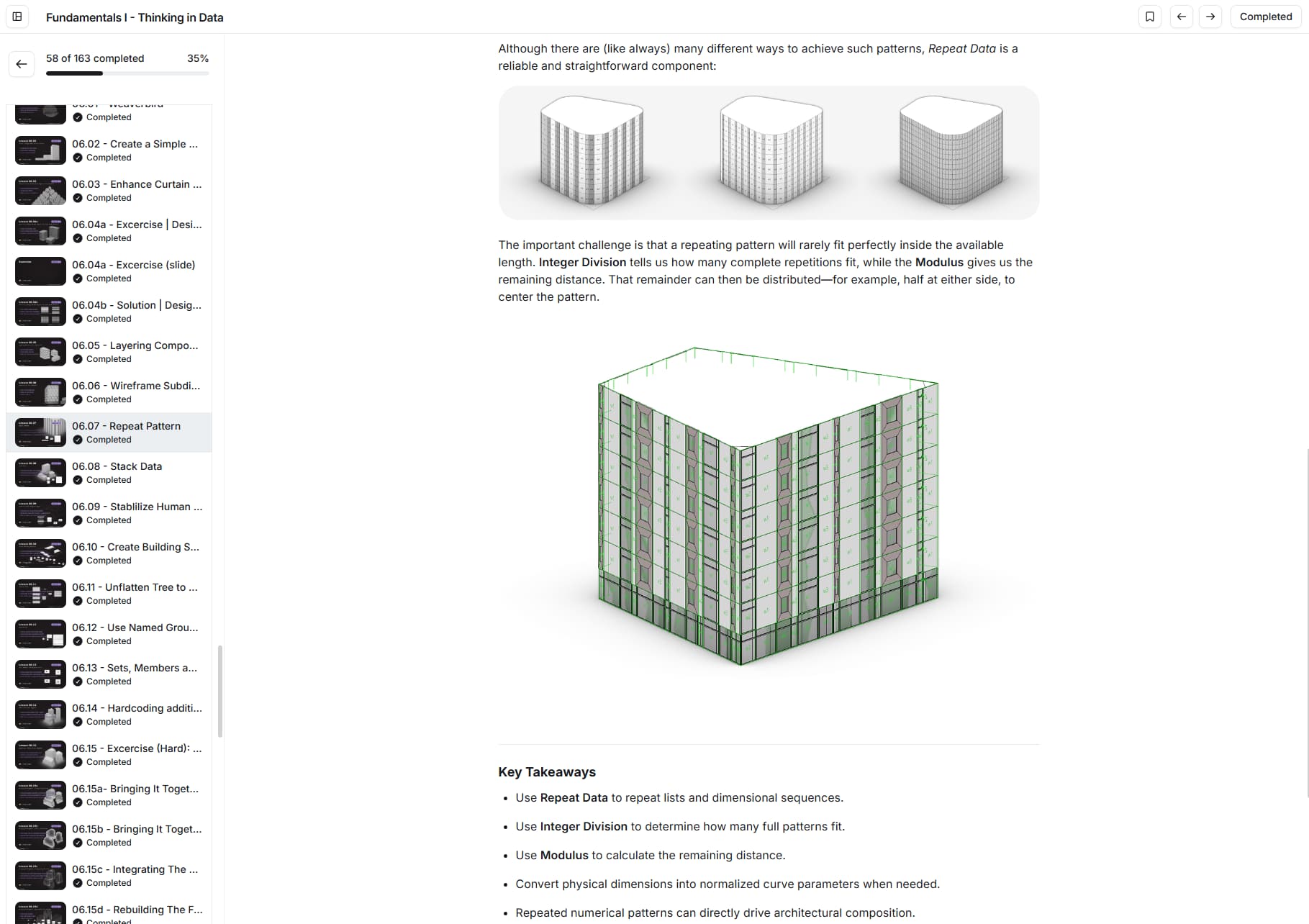
Understand the data behind the geometry
Knowing which component to use is only one part of the process. You also need to know what data it receives, how that data is organized and what should happen when the number of items changes. A definition that works for one arrangement should be understandable when you test another.
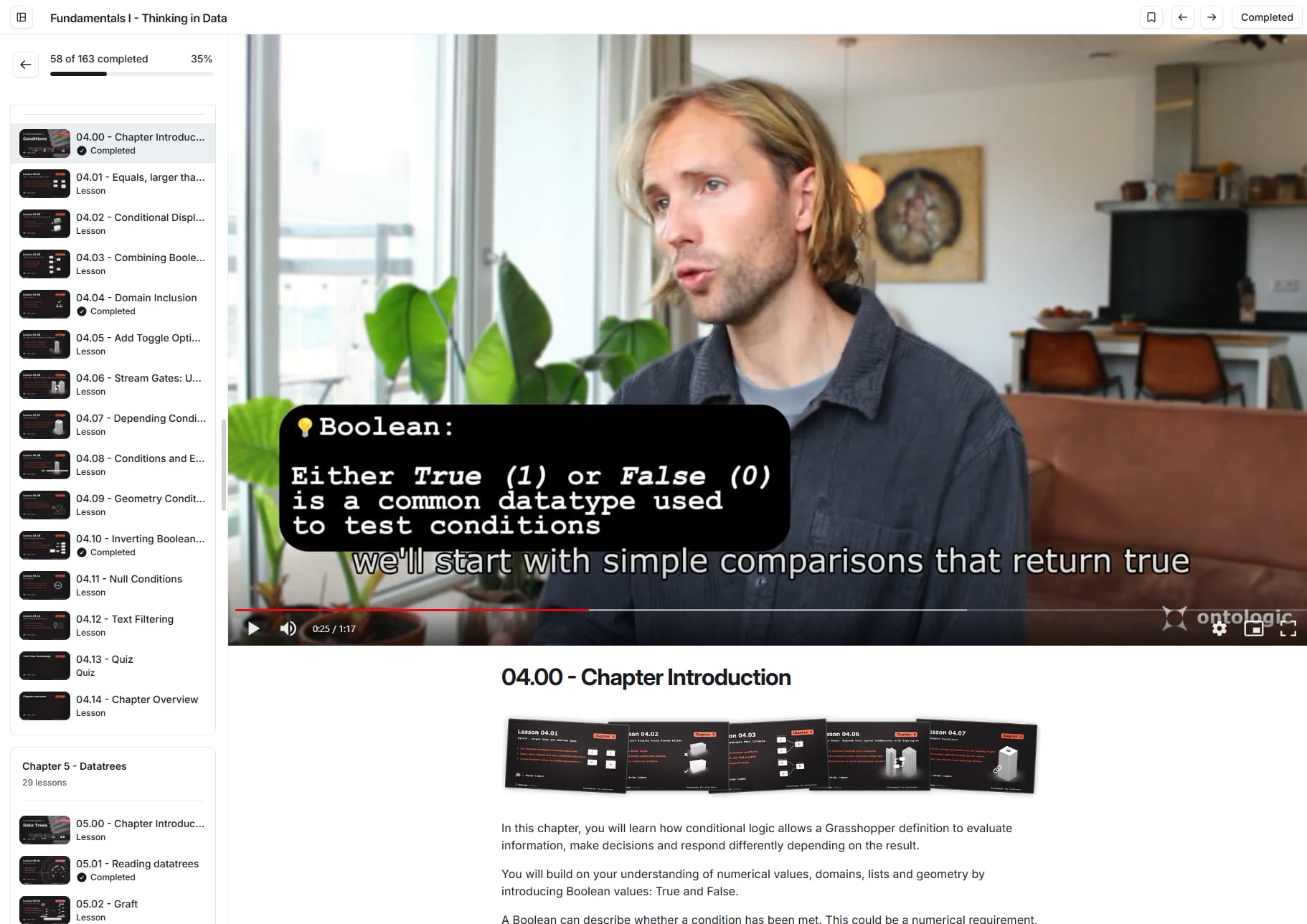
Thinking in Data connects lists, domains, conditional logic, data trees, patterns and sets with practical architectural examples. You learn to reason about data structures and the tradeoffs between different approaches, building toward larger models without losing track of the relationships inside them.
Make change part of the workflow
Real projects change. A height shifts, a repeated element gains a new variation or the same logic needs to serve a different building. These changes reveal whether a definition expresses a coherent system and whether its inputs and outputs are clear.
The course places clean definitions, efficient data handling and reusable logic at the center of the learning process. You practice choosing strategies, organizing your work and understanding why a system behaves as it does. That understanding is what lets you take a useful idea from a lesson into a different project.
Learn by building, testing and revisiting
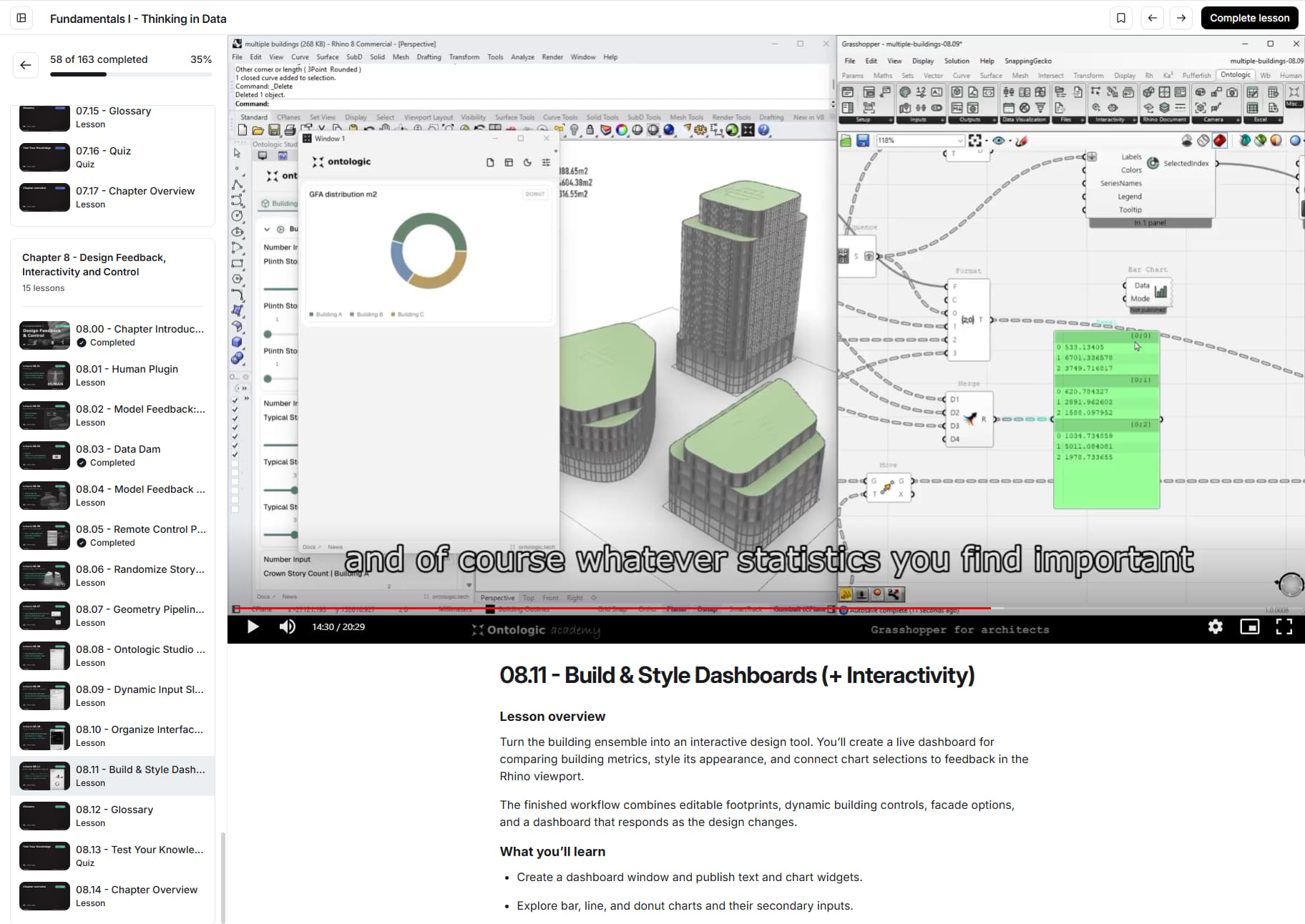
The learning path combines video lessons with exercises, quizzes and step-by-step Grasshopper files. Work through the examples, test your understanding and revisit the underlying logic when your result differs from what you expected.
If you are starting out, the sequence gives you a structured route into computational design. If you already use Grasshopper, the focus on strategies, data organization and tradeoffs gives you a way to examine habits that become difficult to maintain in larger definitions. The course is self-paced, so you can return to a topic as you apply it.
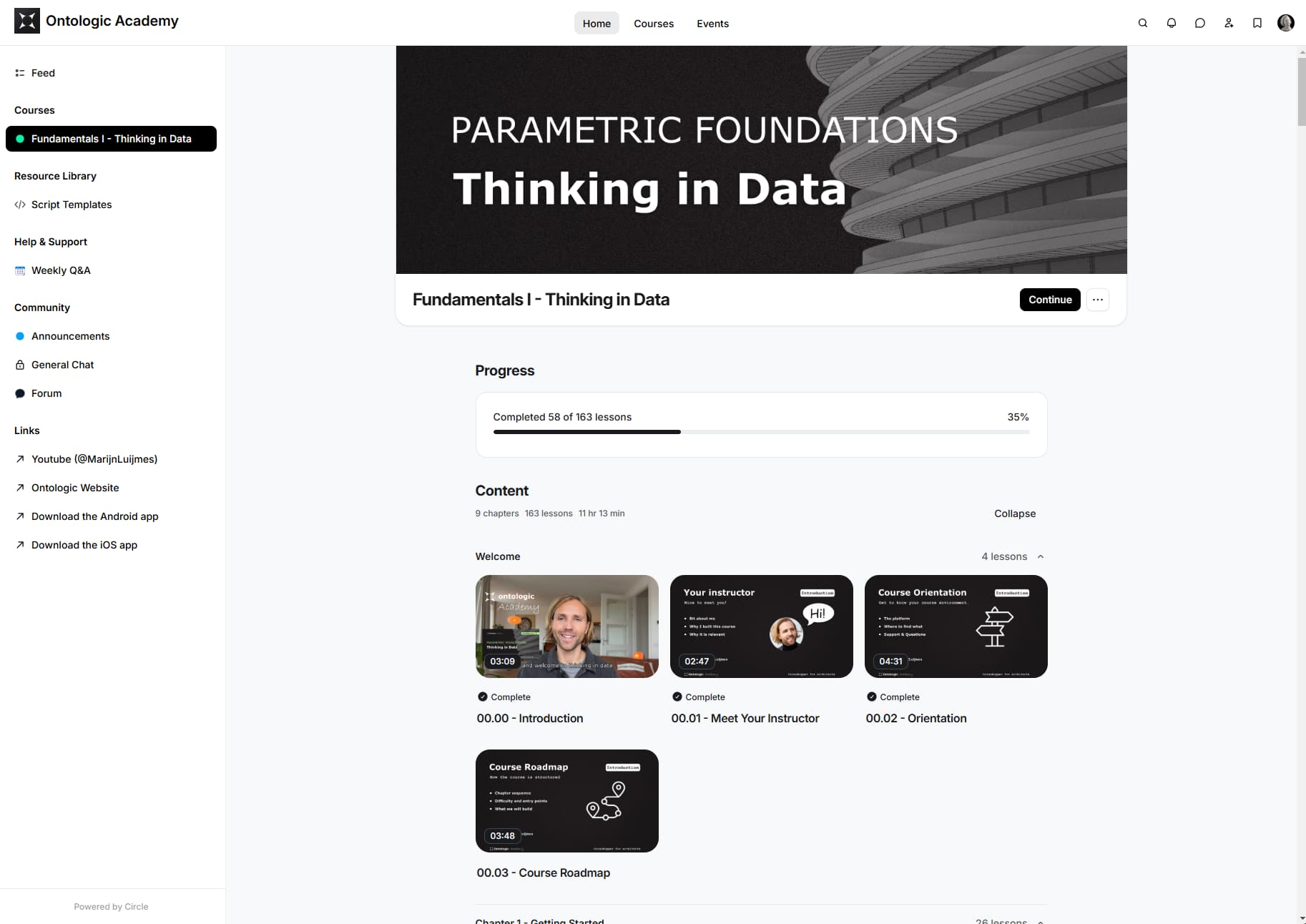
Start with Thinking in Data, build toward what comes next
Thinking in Data is the course available at launch. It forms the first part of Parametric Foundations, alongside the forthcoming Computational Geometry course. People who purchase at this launch will also receive access to Computational Geometry when it is ready.
The broader curriculum builds toward advanced geometry, generative design, performance and analysis, BIM and workflow integration, and AI-augmented design. Those are future stages of the learning path. The current course puts the data and systems thinking in place that makes those later workflows easier to reason about.
Watch the course preview below, then explore the curriculum on the course page. Enrollment takes place in Ontologic Academy on Circle.
From concept to canvas
Watch the Thinking in Data course preview
Meet the course and its approach to building clear, adaptable Grasshopper systems for architecture.
Watch on YouTubeReady to start Thinking in Data?
Explore the full curriculum or enroll in Ontologic Academy on Circle.